Your shoppers are judging you on things they’ll never mention, like an empty shelf, a price that doesn’t match the tag, or a display that never went up. Most won’t complain; they’ll just quietly drive past you to the competitor down the road. Here’s how the world’s biggest brands win that silent vote, store after store, and how you can too.
Most of us have driven past one grocery store to get to another. Maybe it was cleaner. Maybe it always had the brand we wanted. Maybe the loyalty points were worth the extra mile. Small things decide where people shop, and 63% of Americans say a loyalty program alone influences their choice.
The pandemic reshaped how people buy groceries. About 45% of consumers increased their online grocery shopping during COVID-19. Yet the store never lost its pull. Shoppers still want to walk the aisles, pick up the product, and leave with what they came for.
That trip is more than a cart and a checkout line. It is every touchpoint along the way. Was the parking lot clean and were carts in the corral? Was the item on the shelf at the price the shopper expected? Did an associate help when something was hard to find? Together, these moments form one experience. Getting that experience right, store after store, is what the industry calls perfect store execution.
A perfect store combines the right commercial and operational elements to give shoppers a seamless trip. Unilever developed and popularized the concept, and it still uses the name "Perfect Store." Other CPG leaders run the same idea under their own banners. Procter & Gamble calls it the "Golden Store." PepsiCo aims for "Flawless Execution." Coca-Cola runs "Right Execution Daily," a clever nod to its RED branding.
The names differ. The stakes do not. According to Ipsos, 47% of households with children say their primary grocery store is out of one or more items they want at least half the time. Patience is short. More than a third of shoppers (36%) would switch stores after just 4 to 6 missing items, and 23% would leave after only 1 to 3.
Empty shelves are the clearest failure. They are not the only one.
Whatever a company calls its program, most perfect store frameworks rest on the same four pillars. Together they shape what the shopper finds, sees, and pays.
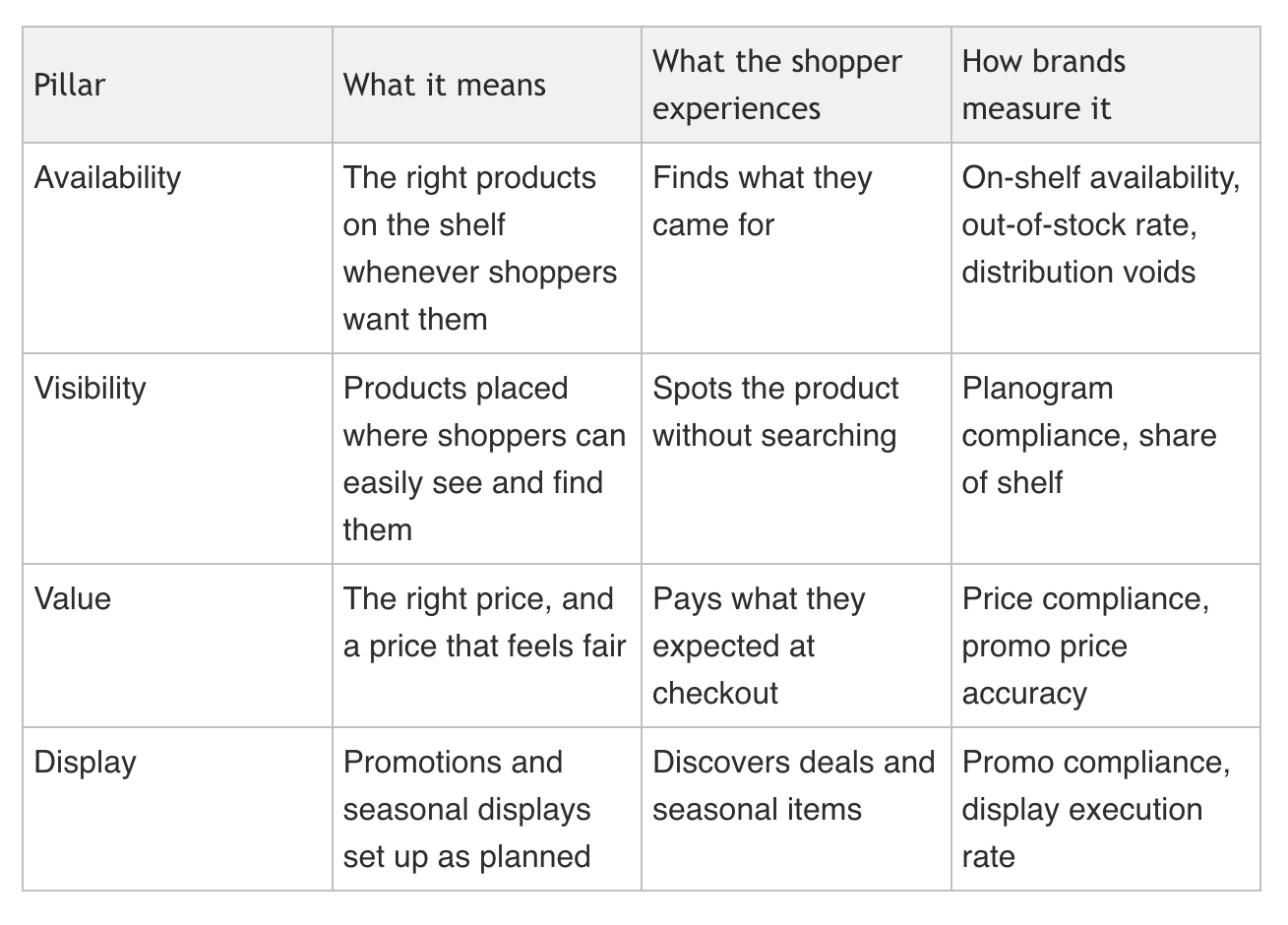
This mix is a starting point, not a formula. The perfect store looks different depending on the objective.
So the first job for any brand is to define what perfect means for its business and which KPIs prove it. Is the goal higher sales comps? Bigger baskets? More transactions? Better reviews? Once those benchmarks are set, the work of activation begins.
A shopper runs out for milk. She leaves with milk, vegetable broth, cheese, and strawberries. She did not plan those purchases. Placement and price made the decision for her. Brands and retailers invest heavily to understand, and shape, these choices.
That understanding needs two kinds of data. Sales data reveals the what: spending by demographic, item mix, and basket size. Focus groups, surveys, and everyday conversations reveal the why. Together they show where the shopper is heading. One clear example is the push toward one-stop shopping, with 27% of shoppers saying non-food products would draw them to a particular store. Brands that read these signals can place, price, and promote with intent.
Compliance matters, but it is a means, not the end. Shoppers will never remember which facings sat side by side. They will remember whether they found what they needed.
The store still has a strong hold on them. 46% of shoppers say they would rather shop in store than online if given the choice. That preference is an opening. Clean aisles, full shelves, and helpful associates win loyalty that delivery apps cannot. The more execution work teams can streamline, the more time and attention they can give to the shopper.
The perfect store is never finished. Burgers and hot dogs lead into July 4th. Backpacks arrive for back to school. Sometimes the shift is far bigger. During the pandemic, retailers rationed high-demand items, made aisles one way, and added sanitizer stations. Many even redesigned parking lots as buy online, pick up in store grew 28%.
With so much constant change, consistency becomes the hard part. Every holiday display and every promotional reset has to land the same way in every store. Leaders need a reliable way to see what is actually on the floor, not what the plan says should be there.
With the strategy set, teams move into execution. This is where promotional plans, product placement, signage, displays, share of shelf, and planogram compliance come to life. It is also where financial discipline shows up, through steady monitoring of margin and price compliance across the year. The best programs give field teams simple tools to audit, share photos, and receive tasks, so the plan and the store stay in sync.
Finally, teams have to prove it worked. That means returning to the original KPIs. Did sales comps rise? Did baskets grow? Did transactions or reviews improve? And what else in the market might explain the result?
For large brands and retailers, manual measurement is slow and error prone. Automated data collection and machine learning deliver consistent results across thousands of stores in minutes. That speed turns measurement into a feedback loop, so teams can spot trends and act on opportunities while they still matter.
There is no one-size-fits-all perfect store. A startup and a national warehouse chain will build very different programs. What they share is the need to measure. Four KPIs do most of the work.
On-shelf availability (OSA). This is the most critical metric of all. An empty shelf stops a sale on the spot and quietly erodes loyalty with every repeat.
Share of shelf. Availability tells you the product is there. Share of shelf tells you how much space it holds against competitors in the category, and that visual presence tracks closely with market share.
Planogram compliance. Headquarters designs layouts from data. Compliance shows whether those layouts actually made it to the store, where they drive visibility and promotional impact.
Sales uplift and basket size. This is where execution meets the P&L. Tying shelf conditions to sales reveals the true return on better merchandising.
Perfect store strategy shows up differently in every category, but the common thread is always the shopper. Each of these brands turns one of the four pillars into a real advantage.
1. Coca-Cola: assortment built for the neighborhood. Under its Right Execution Daily program, Coca-Cola uses local demographics to shape assortment. A convenience store near a construction site stocks its cooler with high-volume sports and energy drinks. A premium grocer in an affluent suburb leans into sparkling waters and craft teas. Same brand, very different shelf.
2. PepsiCo: meeting the shopper beyond the aisle. Frito-Lay rarely lets Tostitos live only in the chip aisle. Clip strips and small displays sit right beside the avocados and salsa in produce. The placement sparks impulse purchases and builds a bigger basket.
3. L'Oréal and Neutrogena: owning a block of the shelf. Walk into Target or CVS and look at the skincare set. Products are grouped tightly into vertical brand blocks in signature colors. In a crowded category, that block becomes a visual anchor the shopper finds in seconds.
The perfect store is not a destination. It is a discipline practiced every day, in every aisle, across thousands of locations. The brands that win treat it that way. They define what perfect means, measure it honestly, and close gaps fast.